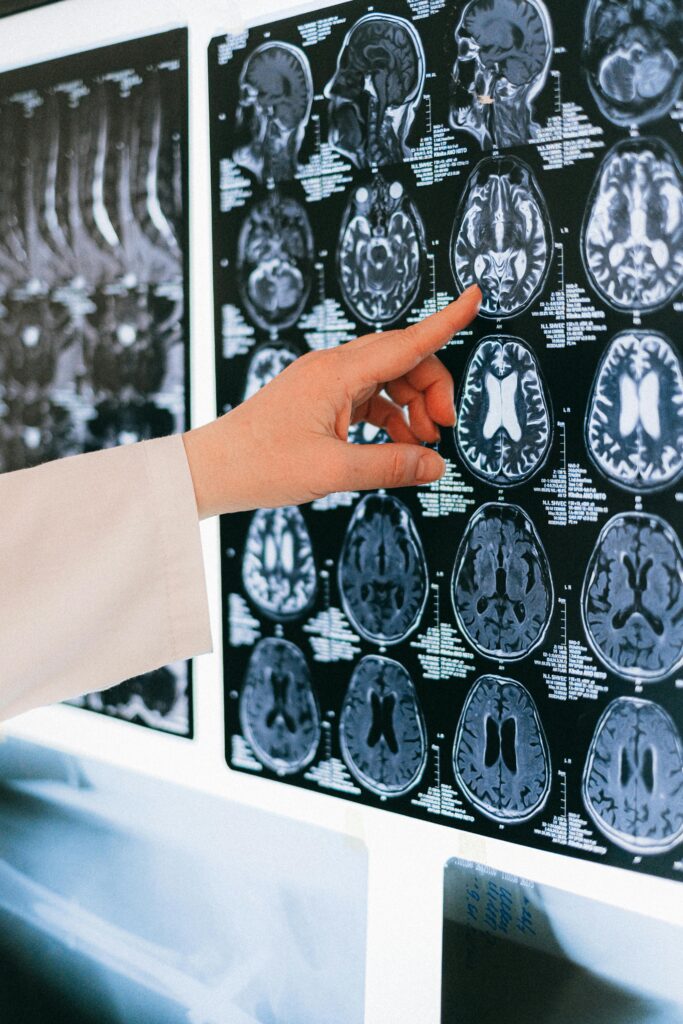
MRI scans let your neurologist see inside your brain and spinal cord, spot MS activity, and track how your condition changes over time. Understanding what these scans show can help you feel more confident about your care and work better with your healthcare team.
Introduction
If you have MS, you’ve probably already had an MRI scan. They can feel overwhelming, especially when your doctor starts talking about ‘lesions’, ‘enhancement’, or ‘disease activity.’
What actually happens during those 30 to 90 minutes in the scanner? What do those bright spots mean? And why does your doctor want another one in six or twelve months?
Key Takeaways
- MRI scans are the best way to find MS lesions in your brain and spinal cord and confirm your diagnosis
- Regular scans, usually every year, help your neurologist spot new changes before you notice symptoms
- A special dye called gadolinium can highlight active inflammation, but it is not always needed for routine check-ups
- Scan results guide treatment decisions, showing whether your current therapy is working
- Knowing what to expect can reduce anxiety and help you get the clearest images
What Is an MRI Scan?
MRI stands for Magnetic Resonance Imaging. It takes detailed pictures of the soft tissue inside your body, like your brain and spinal cord, using magnets and radio waves. There is no radiation involved.
Think of it this way: if your brain were a book, an X-ray might show you the cover, but an MRI lets you read the pages.
This matters a great deal with MS, as MS creates small areas of damage called lesions. These are invisible to the naked eye but show up clearly on an MRI.
Why MRI Matters in MS
Confirming Your Diagnosis
MRI is a core tool for diagnosing MS. When you experience your first MS-like symptoms, scans can show whether there are lesions in more than one area of your central nervous system. This is one of the key things needed to confirm an MS diagnosis.
The 2024 McDonald criteria, the latest international guidelines for diagnosing MS, updated the rules around MRI. They now recognise the optic nerve as a fifth location where lesions can help confirm MS, in addition to the brain, brainstem, spinal cord, and cerebral cortex.
Tracking Disease Activity
MS can be active even when you feel fine. New lesions can appear on an MRI before you notice any new symptoms. This is sometimes called “silent” or “subclinical” activity
Spotting this early gives your neurologist the chance to adjust your treatment before lasting damage occurs.
Monitoring Whether Treatment Is Working
Your MRI results show whether your disease-modifying therapy is doing its job. If new lesions keep appearing despite treatment, it may be time to consider a different medication.
How MRI Scans Work
The Scanner
An MRI machine looks like a large tube or tunnel. You lie on a padded table that slides inside. The machine is quite noisy, expect thumping, banging, and buzzing sounds. Most hospitals or imaging centres offer earplugs or headphones with music to make it more comfortable.
If you feel anxious about enclosed spaces, let your doctor know beforehand. Mild sedation is sometimes an option.
During the Scan
The scan is painless. You will not feel the magnets or radio waves. The most important thing is to stay as still as possible. Even small movements can blur the images.
The radiographer can see and hear you the whole time, and you will have a button you can press if you need to stop.
With or Without Contrast
Some scans use a dye called gadolinium, which is injected into a vein in your arm. This dye lights up areas of active inflammation, helping your neurologist tell which lesions are new and which are old scar tissue.
Current guidelines recommend that gadolinium should only be used when it adds important information that a standard scan cannot provide. For routine check-ups in people who are stable, scans without contrast are often enough.
What Your Neurologist Is Looking For
MS Lesions
Lesions are areas where the protective coating around nerve fibres – the myelin, has been damaged. On an MRI, they appear as bright spots.
MS lesions tend to appear in specific locations. The five key areas are:
- Periventricular: next to the fluid-filled spaces in your brain
- Juxtacortical/cortical: at or just beneath the outer surface of your brain
- Infratentorial: in the brainstem or cerebellum
- Spinal cord: in your neck or back
- Optic nerve: nerve fibres connecting the eye to the brain
New or Growing Lesions
On follow-up scans, your neurologist compares the new images with your previous ones. Finding new lesions does not automatically mean your treatment has failed or that you will have new symptoms. It means your MS is active and your neurologist needs to review your treatment plan.
New MRI Markers
Recent updates to diagnostic guidelines now include two new markers that help confirm MS with greater accuracy -the ‘central vein sign’ and ‘paramagnetic rim lesions.’ These can be visible on certain types of MRI and are highly specific to MS.
How Often Will You Need MRI Scans?
At Diagnosis
When you are first diagnosed, your neurologist will typically arrange a full baseline scan of your brain, and sometimes your spinal cord. This gives a clear picture of where things stand at the start.
Regular Monitoring
For most people with MS who are on treatment, an annual brain MRI is recommended. For those who have been stable for a long time, every two years may be appropriate.
After Starting or Changing Treatment
A follow-up scan around 3–6 months after starting or switching treatment is recommended to provide a new baseline picture.
If Your Symptoms Change
If you develop new symptoms or your existing symptoms get worse, your neurologist will likely order an MRI to understand what is happening.
Preparing for Your MRI
Before Your Appointment
Let your doctor know if you:
- Have any metal implants (such as a pacemaker, cochlear implant, or metal clips)
- Are pregnant or may be pregnant
- Feel anxious about enclosed spaces
- Have kidney problems (relevant if contrast dye is being used)
On the Day
Wear comfortable clothing without metal zippers or underwire. You will need to remove jewellery and watches before the scan. Some centres provide a gown.
You can usually eat and drink normally unless told otherwise.
During the Scan
The radiographer will help you get comfortable. Try to find a position you can hold throughout the scan. You will have earplugs or headphones and a call button to press if needed.
Understanding Your Results
A radiologist looks at the images and writes a report for your neurologist. Your neurologist will then talk you through what the scan shows and what it means for your care. Do not hesitate to ask questions, it is your body and your health.
What the Results Might Mean:
- No new activity: good news; your treatment appears to be working well
- New lesions without symptoms: your neurologist may suggest adjusting your treatment
- New lesions with symptoms: this may indicate a relapse, and treatment options will be discussed
- Stable or improving: some lesions may shrink over time with effective treatment
MRI results are just one piece of the puzzle. Your neurologist considers them alongside your symptoms, physical examination, and overall wellbeing.
Questions to Ask Your Neurologist
You may find it helpful to ask:
- How many lesions do I have, and where are they?
- Are any of these new since my last scan?
- How does this compare to my baseline scan?
- Should we continue my current treatment, or would a change help?
- When will I need my next MRI?
- Do I need contrast dye for future scans?
Common Worries
“I’m worried about the contrast dye.” Modern guidelines suggest gadolinium should only be used when the extra information is clinically necessary. Many people having routine scans do not need it at all.
“I can’t stay still for that long.” Let the radiographer know if you are in pain or struggling. They can adjust your position, use cushions for support, or pause between sequences.
“The scanner makes me feel panicky.” This is very common. Closing your eyes before entering, focusing on slow breathing, or listening to music can all help. If anxiety is severe, ask your doctor about sedation for future scans.
“I want to understand my scans better.” Many imaging centres can provide a copy of your scans on a disc or USB. This can be useful for getting a second opinion or seeing a new specialist. You have the right to access your medical records, including images.
Frequently Asked Questions
Do MRI scans hurt? No, MRI scans are painless. You will not feel the magnets or radio waves. The main discomforts are the noise and lying still for an extended time. If contrast dye is used, you may feel a brief cool sensation in your arm when it is injected.
How long does an MRI scan take? This depends on which parts of the central nervous system are being scanned and whether contrast is used. Brain-only scans tend to be faster than combined brain and spinal cord scans.
Will my MS always show up on MRI? MRI is the most sensitive tool available for detecting MS lesions. However, a small number of people, particularly early in the disease, may have normal-looking scans. Your neurologist will consider all your symptoms and test results together.
How often do I need MRI scans? Most people with MS on treatment have a scan every 1–2 years. Your personal schedule depends on how active your MS is, what treatment you are taking, and whether your symptoms have changed.
What if my scan shows new lesions but I feel fine? This is called subclinical disease activity and is quite common. It means your MS is active even without noticeable new symptoms. Your neurologist will assess whether your current treatment needs to be adjusted.
Are MRI scans safe during pregnancy? The scans themselves are generally considered safe during pregnancy. However, contrast agents are typically avoided unless absolutely necessary. Always tell your doctor if you are or may be pregnant.
Can I get a copy of my scan? Yes. Most imaging centres can provide a copy on a disc or USB. You have the right to access your medical records, including scan images.
Why do I need regular scans if I feel well? New lesions can appear even when you feel fine. Detecting them early means treatment can be adjusted before lasting damage occurs.
What is the difference between an MRI and a CT scan? MRI provides much better detail of brain and spinal cord tissue than a CT scan, and uses no radiation. For MS diagnosis and monitoring, MRI is the gold standard.
References
- Thompson, A.J., Banwell, B.L., Barkhof, F., et al. (2025). Diagnosis of multiple sclerosis: 2024 revisions of the McDonald criteria. The Lancet Neurology. Published September 2025. https://www.thelancet.com/journals/laneur/article/PIIS1474-4422(25)00100-0/abstract
- Wattjes, M.P., Ciccarelli, O., Reich, D.S., et al. (2025). 2024 MAGNIMS–CMSC–NAIMS consensus recommendations on the use of MRI for the diagnosis of multiple sclerosis. The Lancet Neurology. https://www.thelancet.com/journals/laneur/article/PIIS1474-4422(25)00304-7/abstract
- Rocca, M.A., Preziosa, P., Barkhof, F., et al. (2024). Current and future role of MRI in the diagnosis and prognosis of multiple sclerosis. The Lancet Regional Health – Europe, 44, 100978. https://www.thelancet.com/journals/lanepe/article/PIIS2667-7762(24)00145-5/fulltext
- Filippi, M., Bar-Or, A., Piehl, F., et al. (2024). Multiple sclerosis: 2024 update. Nature Reviews Disease Primers / PMC. https://pmc.ncbi.nlm.nih.gov/articles/PMC12238822/
- Wattjes, M.P., Ciccarelli, O., Reich, D.S., et al. (2021). 2021 MAGNIMS-CMSC-NAIMS consensus recommendations on the use of MRI in patients with multiple sclerosis. The Lancet Neurology, 20(8), 653–670. https://doi.org/10.1016/S1474-4422(21)00095-8